
Services
Identity Design
Experience Design
Experiential Design
Virtual Reality (VR)
Event Design
Cerberus Capital
The Shared History Project, led by the Leo Baeck Institute, is a large-scale cultural and educational initiative designed to make over 1,300–1,700 years of Jewish life in German-speaking regions accessible and relevant to modern audiences. It presents historical narratives through curated objects, released over time in both digital and physical formats, including an online exhibition, virtual museum experiences, and traveling installations.
Leo Baeck
Andromeda is building the first decentralized, on-chain operating system designed to simplify and accelerate blockchain development. With a modular framework and seamless multi-chain compatibility, Andromeda empowers developers to build, launch, and scale Web3 applications faster and more efficiently. Its mission is to serve as the foundational layer for the next generation of decentralized innovation.
The Challenge
How might we transform over 1,300 years of complex Jewish history in German-speaking regions into a compelling, accessible, and globally scalable experience that resonates with modern audiences? The project required translating vast, nuanced historical content into engaging digital and physical formats—while ensuring its relevance to contemporary educational and intercultural contexts. At the same time, the experience needed to function as a “museum without walls,” seamlessly connecting interactive web, virtual environments, and traveling installations under a unified narrative and design system.

Identity Design


Experience Design
An interactive timeline guides users through key epochs of Jewish life in German-speaking lands, releasing a new object each week to build an evolving narrative over time. Through detailed storytelling and, in many cases, photogrammetry-based 3D models, users can explore artifacts up close—engaging with historical moments without the need to travel between collections.
Objects such as the earring can be examined in full 360 degrees, offering high-resolution views from every angle and simulating the experience of holding and interacting with a museum piece. These tactile, immersive interactions are designed to deepen engagement and strengthen memory retention, ensuring that the stories and insights of the Shared History Project remain with users long after they leave the digital environment.
Experience Design
Experience Design
Objects such as the earring can be examined in full 360 degrees, offering high-resolution views from every angle and simulating the experience of holding and interacting with a museum piece. These tactile, immersive interactions are designed to deepen engagement and strengthen memory retention, ensuring that the stories and insights of the Shared History Project remain with users long after they leave the digital environment.


Virtual Reality
The site also introduces a fully virtual museum environment, accessible seamlessly across desktop, mobile, and VR headsets, delivering an immersive, next-generation experience. At its core, a continuous metallic tube traces a 1,700-year timeline, serving as both a structural spine and narrative guide. This system transforms into a series of pedestals for key artifacts while opening into interactive portals that lead users into 360-degree photographic views of historically significant locations.
Experiential Design
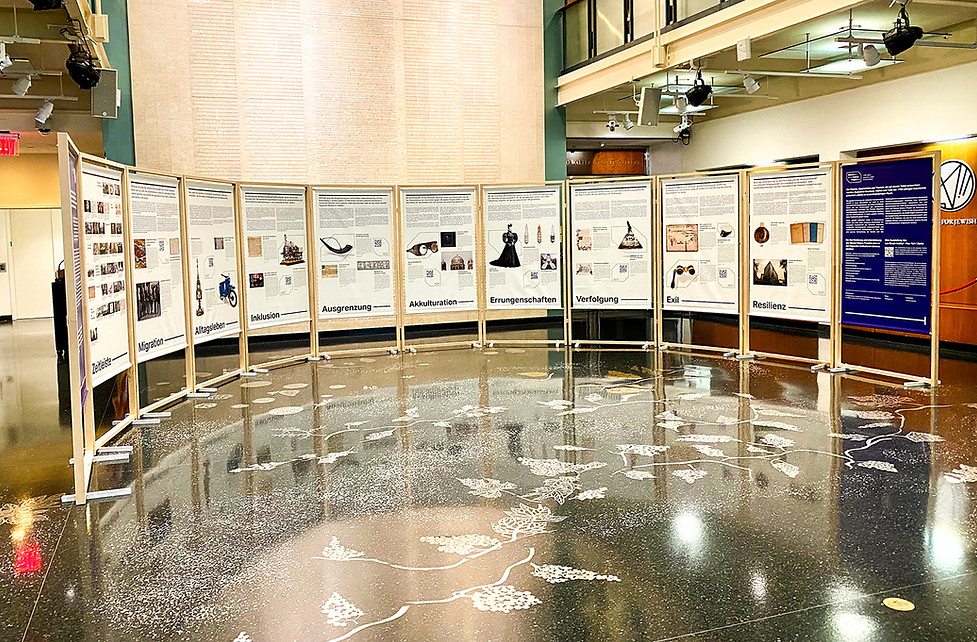
Following the success of the Shared History Project website and virtual museum, demand grew for a more tangible, real-world exhibition that could extend the project’s mission of raising awareness about cultures coexisting within shared environments. In response, 360DESIGN developed a traveling exhibition composed of 12 standing modular panels, designed for flexibility and adaptability across different spatial contexts. Each panel folds and collapses into a custom-fabricated transport case, enabling the exhibition to travel globally between cultural institutions where it can be easily installed, dismantled, and redeployed.
Rather than following a traditional timeline structure, each panel explores a distinct theme that cuts across time, using three historical objects to illustrate its significance. The exhibition was produced in two full sets, one in English and one in German, allowing it to be deployed internationally with contextual relevance.
The Results
The 2021 Shared History Project was widely recognized as a meaningful and timely cultural initiative, successfully bridging academic scholarship with public engagement across both digital and physical platforms. Anchored by the 1,700-year milestone of Jewish life in German-speaking lands, the project resonated with international audiences by presenting a nuanced, accessible narrative of coexistence, contribution, and conflict. The digital exhibition’s serialized release of 52 objects encouraged sustained engagement over time, while its integration of scholarly essays and personal perspectives deepened both credibility and emotional impact.
The physical installations, including the prominent launch at the German Bundestag on International Holocaust Remembrance Day, elevated the project’s visibility and symbolic significance, reinforcing its relevance within contemporary cultural and political discourse. The accompanying traveling exhibition further extended its reach to academic and cultural institutions such as UC Berkeley, enabling broader public interaction. Overall, the project was praised for its thoughtful curation, clarity of storytelling, and its ability to transform complex, layered histories into an experience that was both intellectually rigorous and widely accessible.
